IX Pan Am Aquatics Masters 2024 Trinidad and Tobago
by Steve Fogg
Editor’s note: Globe trotter, Steve Fogg, regales us with tales of his trip and some fantastic swim results!
Trinidad and Tobago. The Country gained Independence in 1962 from England. Trinidad and Tobago is located east of Venezuela, the mountainous northern portion of the island country protects it from the hurricanes. As an English colony, there has been an importation of other cultures from India and Pakistan. This was most noticeable in seeing the places of worship as we traveled from the Capital, Port of Spain, south to the competition venue in Couva.

Historically the economy was sugar cane based, however, the product quality was low yield, so eventually the plantations were abandoned. With the advent of oil and natural gas these new industries became the force in the economy. From our hotel balcony we could see offshore rigs to the north and south. I understand that the main export is LNG (Liquified Natural Gas), and their primary trading partner is Japan. The country imports a lot of vehicles from
Japan, by law they can be no more than four years old.
The standard of living is mixed, with a strong middle class. The housing that I saw would have a mix in a given area, however, there are those enclaves of the well-to-do. Since the topography is mountainous in the north part of the island houses and hotels
were built into the hillsides. I was on the tenth floor. The elevator to my room went down. The bus to the venue served several hotels. With one exception the hotels were tucked in the side of canyons.

I did a half-day city tour that was interesting. Our driver shared a lot of humorous comments. The prison was referred to as the Free Hotel. “Everything is free – free room, free food, but no freedom”. This was in response to my question about social programs
like education, medical, and retirement. The timing of my question was as we drove past the prison.

There were parts of town not to venture into – even cabs won’t go there. As we passed a cemetery our driver mentioned that many of the homeless stayed in many of the monuments in the cemetery as they felt safer there than on the streets.
The climate is tropical with two seasons, wet and dry. Wet is June to December, and dry is December to June. We were there during the
wet season. Showers and thunderstorms were in the daily forecast.

One evening a group of us did a turtle tour. We drove across that mountains where roads might be one and a half lanes wide. There was the heavy Sunday night traffic returning to the city from the beach to add to the experience.
We met our tour people, who had some authority over the beach. We eventually found baby turtle tracks in the sand, and then turtles. These were Leatherback Turtles. There are seven species of turtle that use Trinidad and Tobago for nesting. The female comes ashore in May to lay eggs. She will make multiple trips to deposit eggs in different nest locations, the nest is dug up to four feet below the surface with a large number of eggs deposited. She will do this many nights in a row and then leave.
After hatching, the baby turtles need to dig their way to the surface and then follow the sound of the waves to the water. One in a thousand will survive to return 25 years later to lay eggs. Poaching of adult turtles is illegal. Our guides said that this year they had stopped two poachers. Part of what our guides did was to tag and microchip the adults, this would have happened in May.
My first day in country was breakfast at 6:30, the bus leaves at 7:00 (Island Time). The trip south was like being on I-5, only we were going against the inflow to Port of Spain.
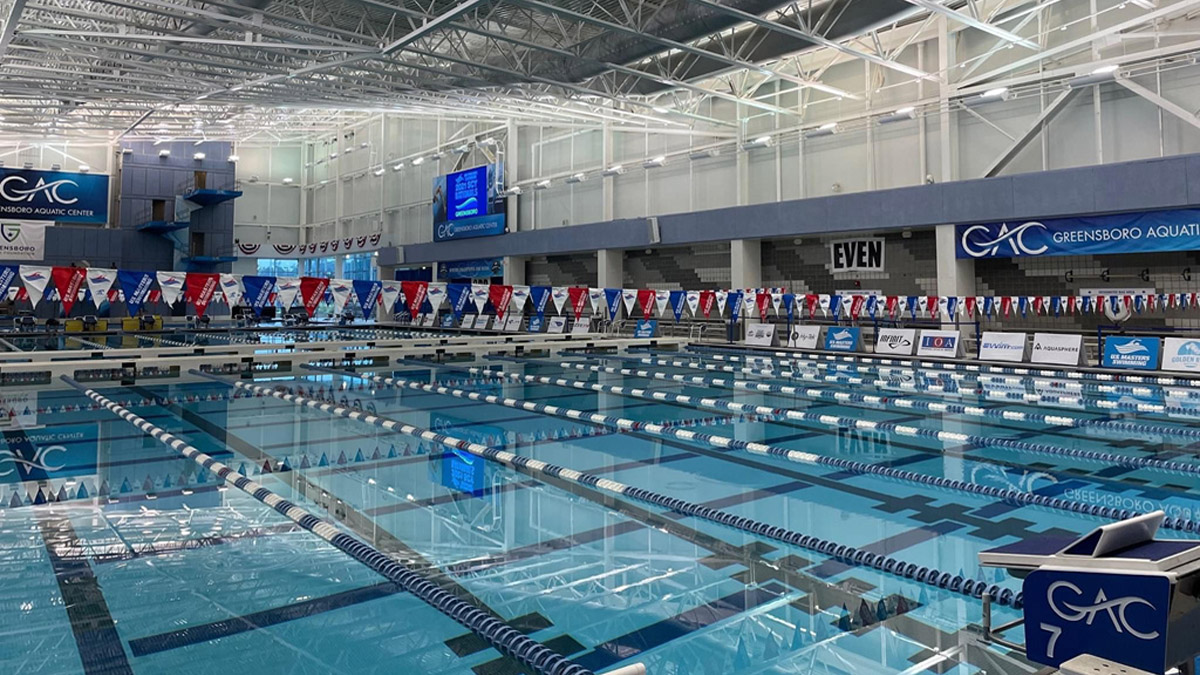
The National Aquatics Center is in a complex with a Crickett Stadium, and a Velodrome located about halfway down island (South) from Port of Spain. There is a 50-meter uncovered outdoor pool and a covered 50-meter pool. The facility has a number of light towers with really big lightning rods. There is also a diving well with springboards and platforms.
Meeting the other swimmers, volunteers, and officials was very positive. They were friendly and helpful even if we did not share a common language. My first event was the 400 IM.

The Official checking credentials was Nadine Day (from USMS). I had met her in Doha. As she was checking, she was saying “I know you, how are you? …. I know you, and I know you”.
There was a gentleman from Uruguay who had had some type of trauma. No ear on the right side and a hearing aid on the left. As we were walking out to the pool for our heat, I stopped and pointed to my left ear, he had not removed his hearing aid and was quite thankful for the reminder, and over the following days we would greet each other as friends.

I had another such experience when I competed against Fernando from Peru. His English is flawless. At the end of the 200 Fly we were hanging on the pool ladder just laughing and enjoying the moment. Too bad that the video of that was out of focus. It was another great moment.

Handshakes after the race were very common. Everyone was very gracious. Our USMS Coach, Bonnie Adams was a fabulous, Cheerleader, Organizer, Competitor, and she provided snacks!
I was pleased with my races. When you sign up for a meet you have no control over how many there will be in your age group, or who will make the trip. So it’s you against the clock.
Of the five events that I swam, three of the Pan Am Aquatics records were set in 2018. I used my times from Doha as entry times except the 200 Back. In the 400 IM, I managed to drop 1.12 seconds.
In the 200 Backstroke, I dropped 0.49, while adding a new style point for goggles. I was not wearing a cap. On the start the top strap of my goggles slipped over my head and lodged under my nose. Now that is a concern, what do I do? Just keep swimming, but maybe a little caution is in order don’t want to lose the goggles.

In the 100 Back, I added 1.88 over Doha and did wear a cap. When we swam the 100 Back it was during a thunderstorm. As I was swimming my final 50, I was seeing lightning flashes in my peripheral vision! That was interesting.
The 200 Fly was my biggest personal accomplishment. For weeks I had fretted over do I have enough air to make a 200 again since Doha. The best I had been able to do was a 100 at KCAC. Well, “just relax and stretch it out, swim to finish” I kept telling myself. As it turned out I dropped 10.41 over my time at Doha!
The last race for me was the 50 back. I dropped 0.40 from my entry time. In the end I had five Gold Medals and one Silver Medal. I’m happy. Then today I looked at the results again and see that I am now the proud owner of the Men’s 75-79 Record in the 200 Fly (old record was from 2022), and the 50 Backstroke (old record was from 2011).
Fernando and I hope to meet again in Singapore next summer, and in Buenos Aries in October of 2026. He has invited me to visit him in Peru after the meet, we will see.
Happy Swimming